
New technologies are fundamentally changing how potential customers search for products in online stores. If you're standing still... you'll likely start losing your competitive edge over time, and that's the first step toward closing your e-commerce business. You can protect yourself from this. All you need to do is start using available technology solutions, such as an AI chatbot, intelligent search engine, and product comparison tool. There are many possibilities, but what should you choose for your business? Read this guide and you'll find it easier to make a decision and start growing your business.
How to Assess Which AI Solutions Are Right for Your E-commerce Business?
The simplest approach is to start with an "X-ray" of your store. Imagine you're looking at the entire purchasing process like a heat map. Then you see the places where the customer pauses, what they ignore, and where they abandon the purchase. These exact points show which AI solutions can deliver results – whether you need a better product search engine, automated support, or perhaps an offer personalization tool.
Methods that can help you...
1. User behavior analysis (GA4, Hotjar)
When you see users spending a long time searching for products in a large fashion store, an AI search engine can suggest sizes, colors, and complete outfits. In the sports industry, AI helps shorten the path to model selection through intent-based filters (e.g., "trail running shoes").
2. Review of repetitive customer service tasks
If customers in an electronics store constantly ask about hardware compatibility, an AI chatbot can automatically indicate which accessories fit their device. Example? In a home furnishing store, it answers questions about dimensions, colors, and variant availability.
3. A/B testing of products and content (Optimize, VWO)
When you don't know which message works best, AI personalization modules help match the offer to customer intent in real time. In the beauty industry, AI can show the customer products suited to their skin type, and in food e-commerce, suggest substitutes and recommendations based on previous purchases.
You don't have to implement AI solutions in your company just because it's trendy and everyone's doing it. In online stores, such systems are slowly becoming essential. You probably know that search results, e.g., in ChatGPT, already show product offers and mentions. You can leverage this potential and give customers access to intelligent solutions that provide more precise guidance, faster service, and real improvements in the purchasing process.
When Is It Worth Considering Implementing AI Solutions in an Online Store?
The best moment is when you see that manual processes can no longer keep up with the number of orders or customer inquiries. In practice, it's as if your store started growing faster than your team can handle. Think about it when:
- customers ask the same questions about deliveries, returns, or product compatibility, and support can't keep up – an AI chatbot can take over a large portion of these topics;
- users get lost in the number of products (e.g., fashion, electronics, sports stores) – an AI search engine helps them find the right model, size, or variant with a single simple query;
- you have many orders outside business hours – AI can guide the customer through the purchasing process, suggest products, and explain offer details just like a consultant would;
- you see abandoned carts – AI can analyze behavior and propose more relevant recommendations or product alternatives.
These signals show that artificial intelligence in online stores is not an add-on but a natural extension of your team's work. Such solutions start functioning as an intelligent layer that improves shopping experiences and streamlines processes without burdening the business with rising operational costs.
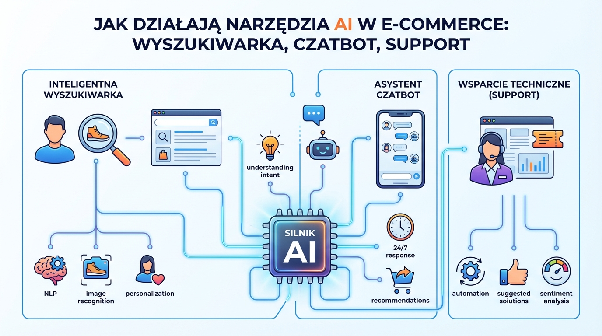
How Do AI Tools Work in Online Stores? Search Engine, Chatbot, and Support in Practice
AI observes what the user is searching for, what questions they ask, and at what point they need support. Then the online store is perceived as expert, intuitive, and the user feels that someone is constantly guiding them through the purchasing process.
AI Product Search Engine in E-commerce
Let's say you have a customer who enters an electronics store and types "laptop for graphic design." Classic filters don't know what this means and will start showing various, not necessarily well-matched results.
The AI search engine understands intent and suggests models with the appropriate graphics card, display, and memory.
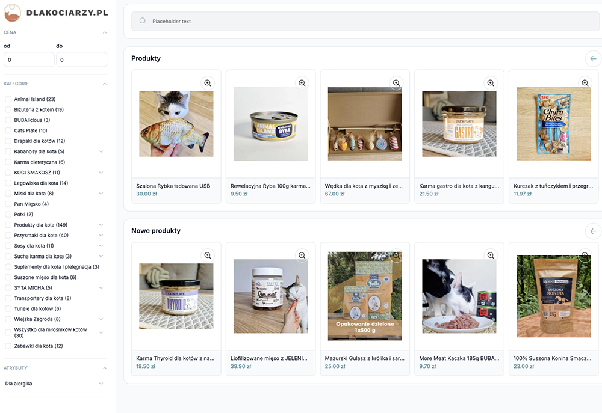
Similarly in a fashion store – you type "pastel wedding dress" and AI shows ready outfits instead of hundreds of random products. The customer reaches what they need faster, and you shorten their path from entering the site to completing the purchase.
Chatbot with AI Support in E-commerce
An AI chatbot works like a consultant who works 24/7 and has constant access to the store's knowledge base. If a customer at 11:45 PM asks whether a given vacuum cleaner fits a specific filter model, AI immediately analyzes the technical data and provides an answer.
Example? In a furniture store, the chatbot helps match dimensions, check color availability, and guides the customer to the right product. The store's classic support is relieved, and customers get immediate assistance in situations where they would normally have to wait until morning.
Product Search Engine and AI Chatbot in Online Stores – Benefits and Risks of Implementation
Implementing AI requires well-organized data, because without it, tools provide incorrect answers or display inaccurate recommendations. A common challenge is also integration with the existing store system – if the product API runs slowly, AI won't be able to operate in real time.
Table 1: Benefits of AI product search engine and chatbot for e-commerce.
| Feature | AI Product Search Engine | AI Chatbot / AI Support |
|---|---|---|
| Role in the store | Helps customers find the right product faster. | Answers questions and guides the customer through the purchasing process. |
| What it actually improves | Shortens time from entering the site to selecting a product. | Reduces the number of tickets and relieves support staff. |
| How it works in practice | Understands descriptive queries, e.g., "winter boots for -10 degrees." | Uses the knowledge base and product information to respond automatically. |
| Benefit for the customer | Less clicking, fewer filters, more relevant results. | Instant response, even outside store business hours. |
| Benefit for the store owner | Better conversion and fewer abandoned carts. | Less time on repetitive questions, greater service availability. |
Source: Own analysis.
It's also worth remembering that a poorly configured chatbot can frustrate customers if it "loops" responses or doesn't have access to the current knowledge base. That's exactly why regular data updates and testing by specialists are necessary, so that AI supports sales rather than creating chaos in customer service.
Frequently Asked Questions About AI Solutions for E-commerce
Still have hundreds of questions and even more doubts? Or maybe you're worried that implemented AI solutions won't translate into better and valuable sales conversions? There's always that risk... and that's exactly why it's worth getting to know this technology from the ground up and understanding that what also matters is a well-developed sales strategy, purchasing process, and marketing.
1. Which AI solutions should be implemented first in an online store?
Most commonly, you start with an AI product search engine or chatbot, because these two tools deliver the fastest and most measurable results. If you see customers having trouble with navigation, the first choice should be an intelligent search engine. When the problem is a large number of inquiries about order status, availability, or product compatibility – it's better to start with a knowledge-base-powered chatbot.
2. How do I know if AI is actually improving my sales?
The simplest way is to monitor three areas: search engine conversion, number of abandoned carts, and average query resolution time in customer service. If search results are more accurate, you'll see more clicks to product pages and fewer returns to category lists. With chat, you'll check the number of automatically resolved tickets and how many interactions ended with a purchase.
3. What mistakes do stores most commonly make when implementing AI?
Most commonly, the data preparation stage is skipped – and that's the foundation. Missing product parameters, incomplete descriptions, or incorrect variants mean AI can't function properly. The second mistake is lack of regular testing. Even the best chatbot needs updates because store policies, pricing, and availability change weekly.
4. Will AI improve my SEO and product visibility?
Indirectly yes – because it improves user experience, and that's a ranking signal for search engines. If customers find products faster and don't repeatedly return to results, algorithms see that the store meets their needs. The clear product data structure you prepare for AI also supports SEO.
5. Can AI help reduce the number of abandoned carts?
It can – if it works in two places simultaneously: in the search engine and in recommendations. The AI search engine guides the customer to the right product faster, reducing frustration. Recommendation modules can suggest alternatives if a variant is unavailable, so the customer doesn't leave the store "empty-handed."